


Chemical plants, water treatment plants, and laboratories all deal with mixtures. These mixtures often need cleaning or separation before the next step. That’s where filtration comes into play. It separates unwanted solid particles from liquid using filters. But it isn’t done in just one way. The two most common methods are gravity and vacuum filtration. At first, both seem similar, but in reality there is a huge difference between gravity filtration and vacuum filtration. So which one should you choose? Feel confused? Worry not! In this guide, I will compare both filtration methods head-to-head. You will learn their key differences and make a wise decision when choosing one. So let’s get started.
Difference Between Gravity Filtration and Vacuum Filtration: Key Differences
There is no doubt that both gravity and vacuum filtration perform the same job. Both types of filtration separate solid particles from the liquid to make it free of contamination. However, they do it differently. How? Let’s look at the key differences that set these two filtration processes apart.
1- Driving Force & Pressure Difference
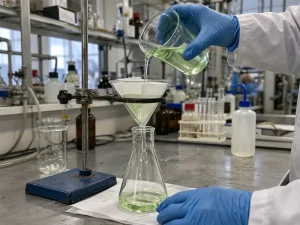
The biggest difference between gravity and vacuum filtration is the force that moves the liquid. As the name suggests, gravity filtration uses natural gravity as the driving force. There is no extra pulling force. In this process, you place the mixture in the funnel with filter paper. Gravity naturally pulls the liquid downward through the filter paper. The liquid passes through the tiny openings; however, the solid particles stay behind on the filter paper.
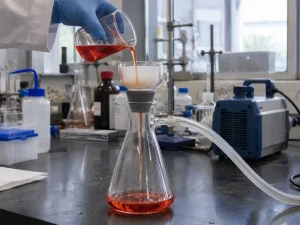
By contrast, vacuum filtration uses a vacuum as the driving force. Here, the vacuum is created below the sintered filter, which lowers the pressure on that side. Now, the pressure above the mixture is higher than the pressure below it. This pressure difference is what pulls the liquid through the filter. As a result, pure liquid comes out; however, solid particles stay on the filter paper. It does not rely on gravity to work.
2- Filtration Speed & Time Required
Speed is another prominent difference between gravity and vacuum filtration. In this regard, vacuum filtration usually excels. Why? The reason lies in the vacuum creation. It creates a pressure difference between the bottom and top of the liquid. This quickly pulls the liquid through the filter, separating solid particles in less time.
However, in gravity filtration, gravity acts as the main driving force. The liquid moves through the filter naturally under the pull of gravity. Nothing actively pushes or pulls it, so the process takes time. If the mixture contains many solids or is a thick liquid, the flow becomes even slower.
3- Equipment Setup & Complexity
The equipment needed for gravity filtration is quite simple. In this process, you just need a funnel, filter paper, and a container to collect the filtered liquid. Place the filter paper in the funnel and let the liquid drain. You don’t need an extra pump, motor, or other connection. Gravity naturally separates the solid particles from the liquid. As a result, it becomes much easier to arrange a gravity filtration setup.
In contrast, vacuum filtration requires a slightly complex setup as you have to pull the liquid through a filter using extra force. The setup usually needs a Büchner funnel, filter paper, a filter flask, tubing, and a vacuum source. You have to connect all these parts securely so that the vacuum can work. This takes time and makes the setup more complex.
4- Main Purpose & Desired Result
What you want to collect at the end of the filtration is another thing that varies between gravity and vacuum filtration. Basically, they aren’t used for the same purpose. If you want the liquid as the main product, gravity filtration is the most reliable option. Suppose a liquid contains unwanted particles after a chemical reaction or mixing process. To separate it, pour the liquid through a filter.
Gravity will do the work, and you can collect the cleaner liquid below. The solid stays on the filter, and you can discard it later. However, sometimes, along with the liquid, solid particles are also valuable. For example, a process produces crystals in a liquid. In that case, you don’t want to lose those crystals. So you can use vacuum filtration, which pulls the liquid away from the solid much faster. The collected solid remains with less liquid clinging to it.
5- Solid Recovery & Liquid Removal
When the solid is what you want to keep, filtration isn’t finished just because the liquid has passed through the filter. It becomes important to recover more solid with little liquid. Vacuum filtration is very handy for this. It doesn’t wait for the liquid to drain naturally; instead, it pulls most of the liquid using vacuum pressure.
This removes more of the liquid from around the solid and leaves the collected material less wet. It means you can recover most of the solid with less liquid. However, in gravity filtration, the liquid drains away naturally. Because of this, some liquid stays trapped in the wet solid. You don’t get fully dried solid particles. You have to dry it for a long time, which makes the process more time-consuming and effort-intensive.
6- Filter Paper & Filter Support
Filter paper is the major part of the filtration. This is another area where gravity and vacuum filtration vary. Generally, gravity filtration uses a cone-shaped piece of filter paper placed inside a funnel. But that filter paper must sit properly against the funnel so the mixture can flow through it without slipping around the edges. However, you don’t need extra paper support. As the liquid moves down, the paper catches the solid particles.
Vacuum filtration also uses filter paper, but it needs extra support. A Büchner funnel or similar vacuum filter holds the paper on a flat, perforated surface. When the vacuum is turned on, the liquid is pulled through the small holes in this support and then into the flask below. This support is very important here. The vacuum creates the pressure difference. This puts more force on the filter paper. So if it is not supported, the filter paper will tear out.
7- Filtrate Quality & Clarity
The filtrate is the liquid that passes through the filter. In both gravity and vacuum filtration, the filter holds back unwanted solid particles. However, the final clarity of the liquid may differ slightly between the two methods. Gravity filtration allows the liquid to pass slowly so that each solid particle remains on the filter paper. There is a very low chance of solid particles passing through the filter paper.
As a result, the liquid comes out with high clarity. But in vacuum filtration, if the vacuum pressure is slightly higher, it can pull solid particles as well. This can sometimes reduce the filtrate quality. However, remember the final quality and clarity of both filtration methods depend on filter paper, its pore size, and the amount of solid. No matter which process you use, if you don’t do it properly, the clarity of the filtrate will be affected.
8- Sample Volume & Handling Capacity
When it comes to sample volume, vacuum filtration clearly wins. It means you can filter a large amount of samples in less time. This is because the vacuum acts as the driving force. The vacuum pulls the liquid quickly, so you can filter a large sample volume in less time. However, gravity filtration takes much time. You pour the mixture into the funnel and let it drain naturally with the help of gravity. Gravity takes a lot of time. So if you use a large volume of liquid, it can take many hours, which makes the process less efficient.
9- Best Applications & Suitable Uses
Due to variation in so many aspects, the usability and best use of both filtration methods also vary. For example, gravity filtration is best for routine work that doesn’t need to be very fast. That’s why it is commonly used in:
- Removing unwanted particles from liquids
- Clarifying chemical solutions
- Filtering laboratory mixtures
- Separating small amounts of solid from liquid
- Preparing a cleaner liquid for the next process
- Filtering heat-sensitive liquids
- Routine water and sample filtration
On the flip side, vacuum filtration is a good option when speed and solid collection matter. You can use it for:
- Collecting crystals after a chemical reaction
- Separating precipitates from liquids
- Recovering useful solid materials
- Filtering mixtures that need faster separation
- Preparing solids for further drying
- Laboratory and industrial solid-liquid separation
10- Overall Cost & Equipment Requirements
Lastly, it comes to cost, where gravity and vacuum filtration differ. Cost mainly depends on equipment setup and needs. As you know, gravity filtration has a much simpler setup, which is why it is a very cost-effective method. It needs only basic items such as a funnel, filter paper, and a container. You don’t need a vacuum pump, tubing, or a special flask. This makes it much more affordable for routine filtration.
However, vacuum filtration costs more because the setup has more parts. Along with the filter and funnel, you will also need a vacuum flask, tubing, and a vacuum source, such as a pump. These extra parts also need proper care and occasional replacement, which further increases its cost. So, its initial cost and maintenance are higher than gravity filtration.
Quick Highlight: No doubt, vacuum filtration has a higher upfront cost. However, it is a very fast process, and you can handle a large volume of the liquid in less time. So for systems that need many batches every day, vacuum filtration becomes worth it. It proves cost-effective in the long term with high accuracy and speed.
Gravity Filtration vs Vacuum Filtration: Which One Should You Choose?
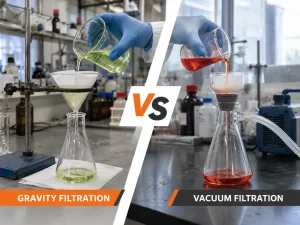
No single filtration method is best for every application. The choice between gravity and vacuum filtration totally depends on what you need.
Gravity filtration is a good choice when you want a simple, low-cost process and mainly need the liquid. It has a simple setup but consumes more time. Vacuum filtration is best when you need faster separation or want to collect the solid with less liquid left in it. It costs more initially but is worth it due to its speed.
In this guide, I have discussed the major differences between gravity and vacuum filtration that you need to know. The better option depends on what you are filtering, what you want to recover, and how quickly you need the job done. For example, if the mixture is small and you have plenty of time, gravity filtration can be the easier way to go. Its setup is simple, the equipment is basic, and there is less to manage.
It is a practical choice for laboratories that don’t prioritize speed. On the other hand, vacuum filtration makes more sense when time matters. It moves the liquid through the filter faster and removes more liquid from a collected solid. No doubt it takes more equipment setup and costs more. But for systems where speed is the main concern, the higher price is worth it.